
刑事侦缉档案4
台风“梅花”即将正面登陆宁波,在外海掀8.8米高狂浪_强台风逼近浙江海域掀起10米巨浪_台风“梅花”或将波及12省市_我的网站

A |
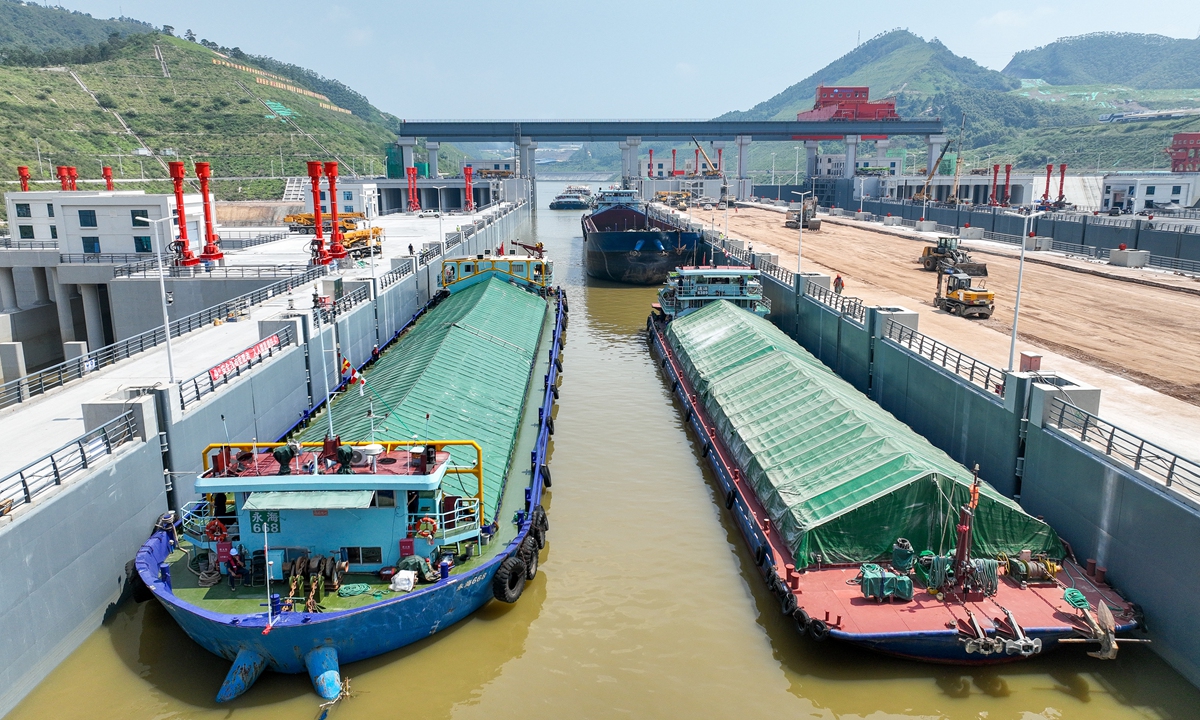
Equipped with China's homegrown BeiDou positioning systems, drones and sensors, four vessels began trial runs along China's Pinglu Canal on Wednesday. The canal, which is planned for opening in September, will greatly inject economic vitality to areas along its route and turbocharge China's trade connection with the ASEAN with its cost-saving transportation, a Chinese analyst said.
The vessels conducting trials on Wednesday represent the main types expected to sail on this canal, namely loaded and unloaded 5,000-tonne ships as well as loaded 3,000-tonne and 1,000-tonne vessels, Xinhua News Agency reported.
The trials began when an unloaded 5,000-ton vessel departed from the Xinfu service area along the canal in South China's Guangxi Zhuang Autonomous Region, the Xinhua News Agency reported.
With sensors collect data on their routes, movements, water currents and safe distances between ships, the tests will assess navigation under both normal and adverse conditions and examine whether the canal's waterways, locks, anchorages, service areas and navigation facilities are ready for operation.
Chinese analysts said the tests starting on Wednesday, days after the canal completed its first full-route patrol, indicated that the canal is one step closer to its scheduled opening in September as final preparation work ramp up.
Zheng Ping, chief analyst at industry news portal chineseport.cn, told the Global Times on Wednesday that as a major project in the nation's water network, the opening of the canal later this year will bring sea changes to areas along its route with fresh economic opportunities with its role as a low-cost enabler for domestic and international trade.
"Inland water traffic has great advantage in transportation capacity and costs. While a train can typically carry 20 40-foot container or more, a waterborne vessel can easily carry over 100 such containers. So a five-times capacity is gained here, greatly reducing transportation costs for goods," Zheng said.
For goods that are not time sensitive, or for bulk cargo such as coal, aluminum or fertilizers, waterborne traffic has unparallel advantage, the expert noted.
The 134.2-kilometer-long Pinglu Canal is a key project of the New International Land-Sea Trade Corridor. With total investment exceeding 70 billion yuan ($10.37 billion), the canal begins at the Pingtang River estuary in Hengzhou, administered by Nanning, follows the Qinjiang River into the Beibu Gulf, according to Xinhua News Agency.
It is China's first major river-to-sea canal project planned and coordinated at the national level since 1949 and is designed to accommodate vessels of up to 5,000 tons.
In addition to facilitating transportation, modern canal system will also have the function of water resource diversion, flood control and irrigation, greatly boosting up local economic development, Zheng said.
Lei Xiaohua, deputy director of the Institute of Southeast Asian Studies at the Guangxi Academy of Social Sciences in South China's Guangxi Zhuang Autonomous Region, told the Global Times on Wednesday that the Pinglu Canal will serve as a new engine for the deep integration of industrial chains between China and ASEAN.
"Raw materials from ASEAN can enter China's hinterland via the Beibu Gulf ports at lower costs, while Chinese exports including aluminum products and building materials can reach Southeast Asia more efficiently," Lei said.
Against the backdrop of deep industrial chain integration between China and Vietnam, the canal, which offers a low-cost, high-capacity transport route, is poised to foster new models of cross-border industrial capacity cooperation, said Lei.
When operational in September, the canal will give inland regions in Southwest China a more direct river route to the sea. Cargo that previously had to travel eastward through the Port of Guangzhou will be able to head south directly toward ports in the Beibu Gulf, shortening some inland waterway journeys by about 560 kilometers, according to Xinhua.
The New International Land-Sea Trade Corridor is an international trade and logistics network connecting China's western regions to ASEAN countries and other overseas markets.
The corridor has continued to record strong trade growth. During the first half of 2026, imports and exports transported through the corridor by its participating regions reached 517.23 billion yuan, up 13 percent year-on-year and setting a new record for the same period, per data released by Chongqing municipal government.
The corridor's rail service handled a record 1.425 million 20-foot equivalent units of cargo in 2025, up 47.6 percent year-on-year. As of early June of 2026, its network reached 593 ports in 128 countries and regions.
。

B | 国家海洋预报台表示,今天凌晨到中午,山东半岛南岸到江苏沿海出现了30到60厘米的风暴增水,上海到浙江宁波出现了40到80厘米的风暴增水,浙江台州到温州沿海出现了30到50厘米的风暴增水,浙江镇海、舟山、乌沙山和石浦潮位站于今天中午出现了达到当地蓝色警戒潮位的高潮位。台风“梅花”即将正面登陆宁波,将产生严重影响,国家海洋预报台今天下午继续发布海浪红色警报及风暴潮橙色警报。海浪警报(红色)。图源:国家海洋预报台风暴潮警报(橙色)。

C | 图源:国家海洋预报台海浪方面,受今年第12号台风“梅花”(强台风级)的影响,预计9月14日夜间至15日白天,东海南部将出现6到10米的狂浪到狂涛区,东海北部、黄海南部将出现3到5米的大浪到巨浪区,近海海域海浪预警级别为橙色;上海、浙江北部近岸海域将出现4到6米的巨浪到狂浪,该近岸海域海浪预警级别为红色,浙江南部、江苏南部、山东南部近岸海域将出现3到4米的大浪到巨浪,该近岸海域海浪预警级别为黄色,江苏北部近岸海域将出现2到3.3米的中浪到大浪,该近岸海域海浪预警级别为蓝色。国家海洋预报台提醒,在上述海域作业的船只需注意安全,沿海各有关单位提前采取防浪避浪措施。风暴潮方面,预计9月14日下午到15日下午,辽宁至山东半岛北部沿海将出现40到110厘米的风暴潮增水,山东半岛南部至江苏南通沿海将出现60到150厘米的风暴增水,长江口至浙江宁波沿海将出现130到280厘米的风暴增水,浙江台州沿海将出现30到80厘米的风暴增水。此外,上海市和浙江省嘉兴市的风暴潮预警级别为橙色,河北省唐山市、山东省日照市、浙江省绍兴市、宁波市和舟山市的风暴潮预警级别为黄色,天津市、河北省沧州市、山东省滨州市、潍坊市、烟台市和江苏省连云港市的风暴潮预警级别为蓝色。国家海洋预报台提醒,沿海政府及相关部门应按照职责做好防御风暴潮的应急抢险工作;组织各类船只回港避风,加固沿海渔业养殖水产设施和渔港设施,相关海上作业人员及时撤离;关闭沿海危险区域浴场和游乐设施,禁止人员到海边游玩;加强沿海海堤、水闸等设施的巡查,薄弱地区和危险地区的海堤及时加固除险,必要时,相关人员撤离转移到安全地带。编辑 樊一婧 校对 李立军返回搜狐,查看更多责任编辑:
Current article:http://tra8sa.saorongriwazhaofutouzhaojie.cfd/9clyya/uk5v.html
Published on:16:18:18